Why choosing a generic website builder stalls digital product stores
Typing 'best ecommerce platform' or 'website builder' into search pulls up dozens of general shopping carts built around cardboard boxes, pallet inventory, carrier weight brackets and brick-and-mortar retail point-of-sale terminals. For an agency selling B2B Notion workspaces, a programmer distributing software serials, or a creator running a community VIP hub, physical ecommerce bloat introduces extra apps, forced billing-address checkout screens and fragile webhook integrations.
Choosing the right online store builder for digital commerce comes down to three questions: how seamlessly does the platform deliver protected files or single-use keys, how much margin disappears to percentage transaction commissions or third-party app stacks, and can buyers discover your catalog both on Google Search and inside active Discord communities?
Compare cloud based ecommerce platforms: Cartcord vs Shopify vs WooCommerce
Shopify dominates physical direct-to-consumer retail, yet its digital story carries real overhead. Shopify Starter ($5/mo) omits custom storefront catalogs and standard App Store integrations, while Shopify Basic ($39/mo monthly, or $29/mo billed annually) plus third-party license-key and expiring-download apps ($9–$30/mo) and external gateway surcharges quickly lifts monthly software spend above $60—still leaving you without native Discord `/store` commands.
Self-hosted WooCommerce gives WordPress teams deep theme flexibility for zero license fee, yet requires you to pay for fast managed hosting, security patching, digital-download plugins, caching configuration and custom Discord webhook maintenance. Cartcord functions as a purpose-built cloud based ecommerce platform strictly for digital SKUs: public localized storefronts, Basic+ single-use Vault uploads, atomic CSV serial key allocation, one-time Discord role grants and direct Live PayPal settlement come built in from $0 Free up to $129.99 Enterprise at 0% platform sales commission.
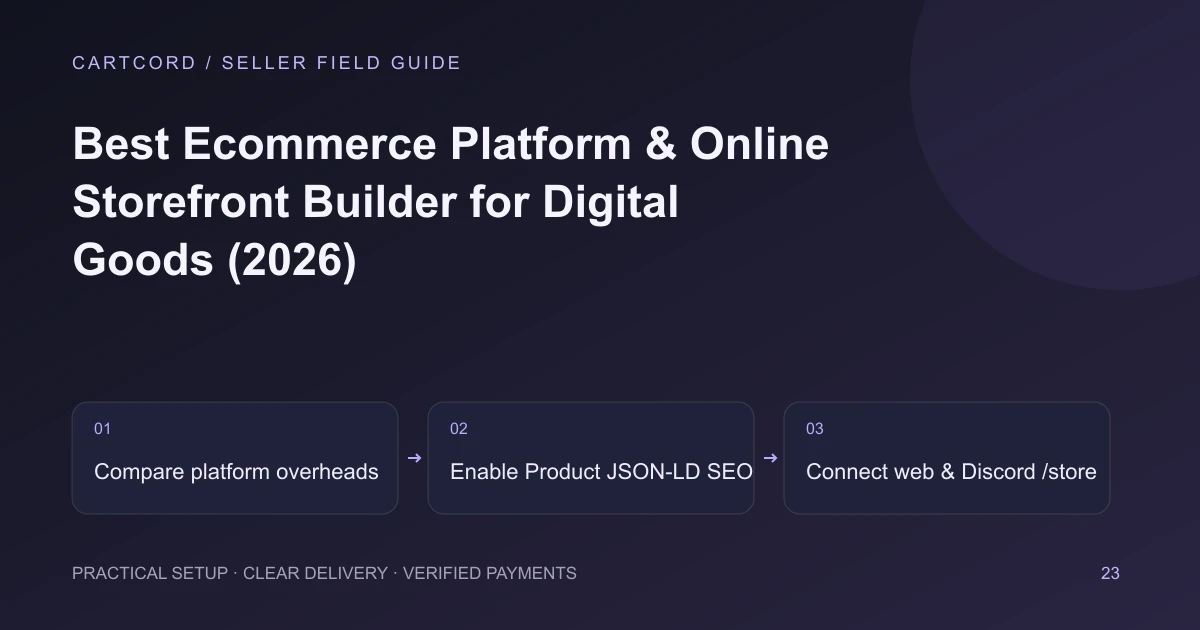
- 01
Compare platform overheads
- 02
Enable Product JSON-LD SEO
- 03
Connect web & Discord /store
Before promoting any digital storefront publicly, verify your full workflow end to end: test Live PayPal checkout using an ordinary non-staff Discord account, check Manage Roles hierarchy above every purchasable role, confirm single-use license key stock or protected download links, and keep delivery recovery instructions clear at /purchases.
Cartcord charges 0% sales commission on flat plans ($0 Free, $9.99 Starter, $29.99 Basic, $59.99 Pro, $129.99 Enterprise), while PayPal processing fees and applicable platform eligibility rules—such as Tebex for FiveM and RedM server monetization—remain the merchant's responsibility.
Technical fulfillment specs: Discord slash commands /store, /products, /buy, /purchases and /help; Discord OAuth2 web authentication; Live PayPal direct payouts; protected Basic+ downloads, single-use CSV license keys with optional Ed25519 checks, Manage Roles grants and Enterprise Fraud Guard webhooks.
What about Payhip, Gumroad and B2B digital storefront workloads?
Marketplace-heavy platforms prioritize instant hosted signup over long-term margin. Gumroad's flat 10% commission (+ payment processing) takes $100 out of every $1,000 sold, plus Payhip Free deducts 5% unless upgraded to $29/mo Plus or $99/mo Pro. Keeping small free tiers while comparing scaling math protects profitability once order velocity crosses even $300–$500/month.
For software vendors handling B2B ecommerce platform buyers—selling multi-seat team toolkits, agency design systems, or developer SDK keys via PayPal invoice/checkout—pair deterministic key pools with scoped REST API endpoints (`products:read`, `orders:read`, `stock:write` on Cartcord Pro/Enterprise) and documented Ed25519 signature verification rather than hacking manual license spreadsheets.
Real total-cost comparison at $2,000/mo in digital product orders
Headline pricing tables disguise real monthly expenses because third-party digital plugins and percentage fees hide outside the base plan price. Compare eighty $25 digital sales ($2,000 gross revenue monthly before payment gateway processing across US buyers):
• **Gumroad**: `10%` platform fee = **$200/month** deducted before processing; • **Payhip Free / Plus**: **$100/month** on Free (5% fee) or **$29/month** Plus ($99/mo Pro at 0%); • **Shopify Basic + Digital Apps**: `$39/mo` monthly Basic (`$29` annual) + `$15–$25/mo` third-party license key & expiring link app + possible third-party provider fee = **~$54–$84/month**; • **Cartcord Basic ($29.99/mo) or Pro ($59.99/mo)**: `0%` platform fee across 150 to 1,000 monthly orders with Vault file links, CSV keys, Discord role automation, coupons (Pro) and Store Docs (Pro) already included.
How to design an ecommerce website for SEO and organic Google rankings
Launching a pretty online storefront without technical SEO leaves your catalog invisible unless you continuously buy ads or post daily social reels. High-ranking digital storefronts get four structural details right from day one:
1) Clean descriptive URL slugs paired with unique `<= 65` character title tags and benefit-driven meta descriptions; 2) Rich `Product` + `Offer` + `BreadcrumbList` JSON-LD structured data so search engines parse live pricing and availability accurately; 3) Fast Largest Contentful Paint using compressed `.webp`/`.jpg` cover thumbnails without heavy third-party script trackers; and 4) True multilingual localization with proper `hreflang` annotations instead of client-side flag widgets.
Building an online store step-by-step without complex app stacks
You do not need ten paid plugins to start creating an online store cleanly. Begin by verifying ownership of one core flagship product (for instance, a starter code kit or template library) with clear preview images and transparent refund terms. Connect Live PayPal Client ID and Secret inside Dashboard → Store Settings, run one real small-dollar live test order cleanly, and verify both DM delivery and `/purchases` buyer history.
As your catalog matures beyond 10 SKUs, add percentage or fixed promotional coupons, unique creator referral coupons to track partner launches, and structured Pro Store Docs so customers troubleshoot setup inside your own searchable domain rather than pinging community staff.
Honest buyer checklist: when to choose Shopify or WooCommerce instead
No single ecommerce website template fits every merchant. Keep Shopify or WooCommerce whenever physical merchandise, apparel sizing variants, local pickup retail POS hardware, multi-warehouse shipping zones or complex tax-nexus shipping rules define your store. Similarly, if your software requires automated monthly recurring SaaS seat billing or seller Stripe checkout today, keep recurring seats on a dedicated recurring billing tool while running one-time packs and community perks cleanly on Cartcord.
Official sources
- Shopify Official Pricing & Starter Plan Limits
- Google Search Central: Product Structured Data Guidelines
- Payhip Official Pricing Tiers
Sources checked on 2026-11-28. Review current provider terms before making a decision.
- Compare Shopify Digital Products vs CartcordRelated guide
- Compare Podia & Sellfy vs Cartcord flat tiersRelated guide
- Preview CSV store exports safely before migratingRelated guide
- Follow the 5-minute storefront launch guideRelated guide
Frequently asked questions
Is Cartcord an ecommerce platform or just a Discord bot?
It is both: every server gets a Google-indexable public web storefront with structured JSON-LD metadata across 12 languages plus native Discord slash commands (/store, /products, /buy, /purchases) sharing one inventory and order database.
Does Cartcord work as a free online store builder to start?
Yes. Cartcord Free ($0/month forever) lets you publish up to 3 active products and process up to 5 monthly orders with 0% Cartcord sales commission via your connected Live PayPal account.
Can B2B software makers automate stock and order syncs?
Yes. Pro ($59.99/mo) unlocks scoped API keys (products:read, orders:read, stock:write) and Store Docs, while Enterprise ($129.99/mo) adds HMAC-SHA256 signed order webhooks and unlimited products/orders.
How does Cartcord handle ecommerce SEO across international markets?
Public pages render localized paths across 12 supported languages (English, German, French, Spanish, Dutch, Polish, Portuguese, Turkish, Japanese, Korean, Hindi and Russian) with canonical tags, sitemap coverage and Product JSON-LD.