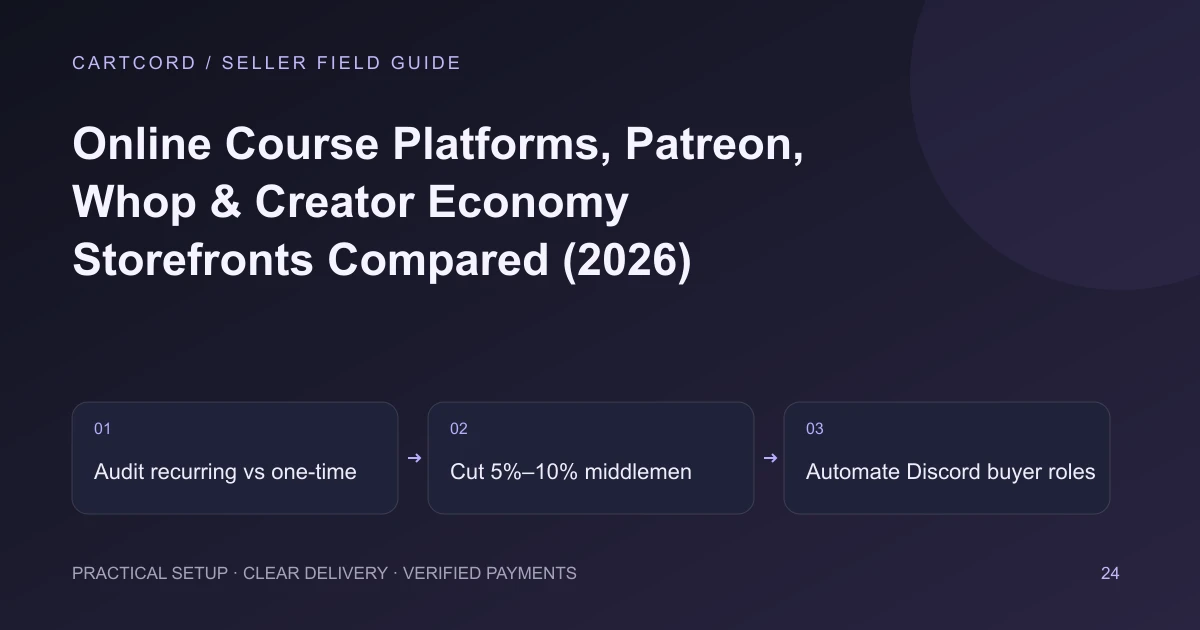
Why the 2026 creator economy splits into four distinct storefront models
Searching for an 'online course platform' or 'membership website' throws creators into one blurred comparison table mixing newsletter tools, SVOD video streamers, marketplace communities and mobile bio links. Treating them as interchangeable costs thousands of dollars in avoidable platform fees and awkward migration headaches later.
Nearly every creator platform falls into one of four operational buckets: (1) Hosted LMS / Subscription Video on Demand (SVOD) platforms built around sequential video lessons and progress quizzes; (2) Recurring Supporter & Newsletter Memberships (`Patreon`, `Substack`); (3) Creator Marketplaces & Link-in-Bio Hubs (`Whop`, `Stan Store`, `Beacons`, `Ko-fi`); and (4) Commission-Free Community & Digital Commerce Storefronts (`Cartcord`).
Comparing Patreon, Substack and subscription video on demand services
Patreon remains the benchmark when podcasters (`Patreon for podcast`), illustrators, YouTube essayists and musicians monetize ongoing monthly fan pledges with private RSS audio feeds and tiered sponsor perks—understanding clearly that Patreon's standard platform commission sits around 8%–12% depending on plan and legacy terms plus payment processing. Substack wins for long-form newsletter writers who want built-in recommendation network discovery in exchange for a 10% revenue share (+ Stripe fees) on paid subscriptions.
Traditional online course creators seeking structured modular video libraries, student quizzes and completion certificates typically look at Teachable or Podia ($49/mo Mover + 5% fee, or $99/mo Shaker 0%). Where pure SVOD streaming (subscription video on demand service) with DRM playback matters most, dedicated video LMS hosts earn their fee; when your education offer actually runs via PDF playbooks, Notion academies, prompt databases, code repositories and live Discord feedback cohorts, paying $49–$159/mo for an LMS video player is pure bloat.
- 01
Audit recurring vs one-time
- 02
Cut 5%–10% middlemen
- 03
Automate Discord buyer roles
Before promoting any digital storefront publicly, verify your full workflow end to end: test Live PayPal checkout using an ordinary non-staff Discord account, check Manage Roles hierarchy above every purchasable role, confirm single-use license key stock or protected download links, and keep delivery recovery instructions clear at /purchases.
Cartcord charges 0% sales commission on flat plans ($0 Free, $9.99 Starter, $29.99 Basic, $59.99 Pro, $129.99 Enterprise), while PayPal processing fees and applicable platform eligibility rules—such as Tebex for FiveM and RedM server monetization—remain the merchant's responsibility.
Technical fulfillment specs: Discord slash commands /store, /products, /buy, /purchases and /help; Discord OAuth2 web authentication; Live PayPal direct payouts; protected Basic+ downloads, single-use CSV license keys with optional Ed25519 checks, Manage Roles grants and Enterprise Fraud Guard webhooks.
Real annual creator cost math across $3,500/month in digital cohorts
Put recurring SaaS bills and commission cuts side by side before locking an entire curriculum behind a single platform. Suppose a creator runs thirty-five $100 cohort/resource sales monthly ($42,000/year gross volume before standard gateway fees):
• **10% Revenue Cut Platforms (Patreon/Substack/Gumroad style)**: **~$4,200/year** deducted in platform commissions; • **Stan Store Creator Pro ($99/mo) / Podia Shaker ($99/mo)**: **$948–$1,188/year** fixed fees before adding Discord fulfillment bots; • **Cartcord Pro ($59.99/mo or $599/yr annual)**: **$599–$719.88/year** total SaaS cost with `0%` commission, promotional coupons, unique referral coupon rewards, hosted Store Docs and automated Discord role assignment—plus `$0/mo` Free and `$9.99–$29.99` Starter/Basic rungs for early launches.
Where Cartcord fits for cohorts, toolkits and paid Discord communities
Whenever your monetization centers on downloadable course toolkits, Figma/Notion study systems, developer code starters, one-time VIP Discord role access or standalone community cohorts sold through PayPal, Cartcord eliminates percentage sales commissions (0% Cartcord cut from Free $0 through Enterprise $129.99) while delivering directly via both web checkout and native `/store` commands in Discord.
Instructors teaching live weekend workshops or coding bootcamps can pair unlisted video links or private Notion portals delivered securely as private links alongside automated `Manage Roles` channel entry—letting buyers check out in two taps inside Discord and revisit receipts permanently at `/purchases` without moderators policing manual role claims.
Important transparency check: what NOT to move onto Cartcord yet
Good creator strategy stays honest about tool boundaries so you never ship a broken student experience. Cartcord currently settles one-time PayPal checkouts directly into the creator's Live PayPal account; automated recurring buyer subscriptions, self-hosted SVOD video streaming libraries, RSS podcast token feeds, and seller Stripe checkouts are not active on Cartcord in this release.
Keep recurring monthly patron pledges on Patreon or Substack if ongoing rebilling is core to your income, and route your one-time course bundles, code templates, server perks, presets and software keys through Cartcord so you keep 100% of gross sales minus standard PayPal commercial fees.
Side-by-side platform checklist before launching your next creator product
1) If selling monthly audio shows (`Patreon for podcast`) or subscriber newsletters -> keep RSS/newsletter rebilling native on Patreon or Substack; 2) If selling multi-module hosted video exams -> evaluate Teachable or Podia; 3) If monetizing TikTok calendar calls -> test Stan Store; 4) If selling digital kits, plugins, Notion academies, keys or one-time Discord community roles via PayPal -> start free on Cartcord ($0 Free tier) and eliminate percentage revenue drains permanently.
Official sources
- Patreon Official Creator Pricing & Platform Fees
- Substack Publisher Fees & Revenue Terms
- Podia Official Pricing & Transaction Fees
Sources checked on 2026-11-28. Review current provider terms before making a decision.
- Compare Stan Store vs Cartcord pricingRelated guide
- Compare Whop vs Cartcord Discord storesRelated guide
- Compare Ko-fi Shop & Gold vs CartcordRelated guide
- Automate one-time Discord buyer roles safelyRelated guide
Frequently asked questions
Can I run a paid Discord community without coding webhooks from scratch?
Yes. Cartcord connects Discord OAuth2 and Manage Roles natively to verified Live PayPal checkouts—buyers either run /store inside Discord or use your public store URL and receive their role automatically once payment settles.
How does Stan Store pricing compare with Cartcord Pro?
Stan Store bills $29/mo (Creator) or $99/mo (Creator Pro, required for funnels and discount codes) after a 14-day trial. Cartcord offers a permanent $0 Free tier, $9.99 Starter, $29.99 Basic with Vault protection, and $59.99 Pro including coupons, creator referrals and Store Docs.
Should podcasters leave Patreon for Cartcord?
Only for one-time bonus packs or Discord VIP community passes. Keep recurring monthly supporter pledges and private patron RSS audio feeds on Patreon since Cartcord focuses on one-time digital orders rather than recurring rebilling.
What if I want to migrate course toolkits away from Gumroad, Whop or LaunchPass?
Export your SKU list cleanly, preview product formatting in /tools/store-migrator, connect Live PayPal in Dashboard -> Settings, and test one digital delivery on Free ($0) before shifting community links.